A chance discovery: Rare moon rock sparks new research
During a private visit to a museum, a researcher from Freiberg discovered a rare sample of moon rock. The sample was scanned using a CT scan at the Technical University of Freiberg.
Read Aloud
0:00
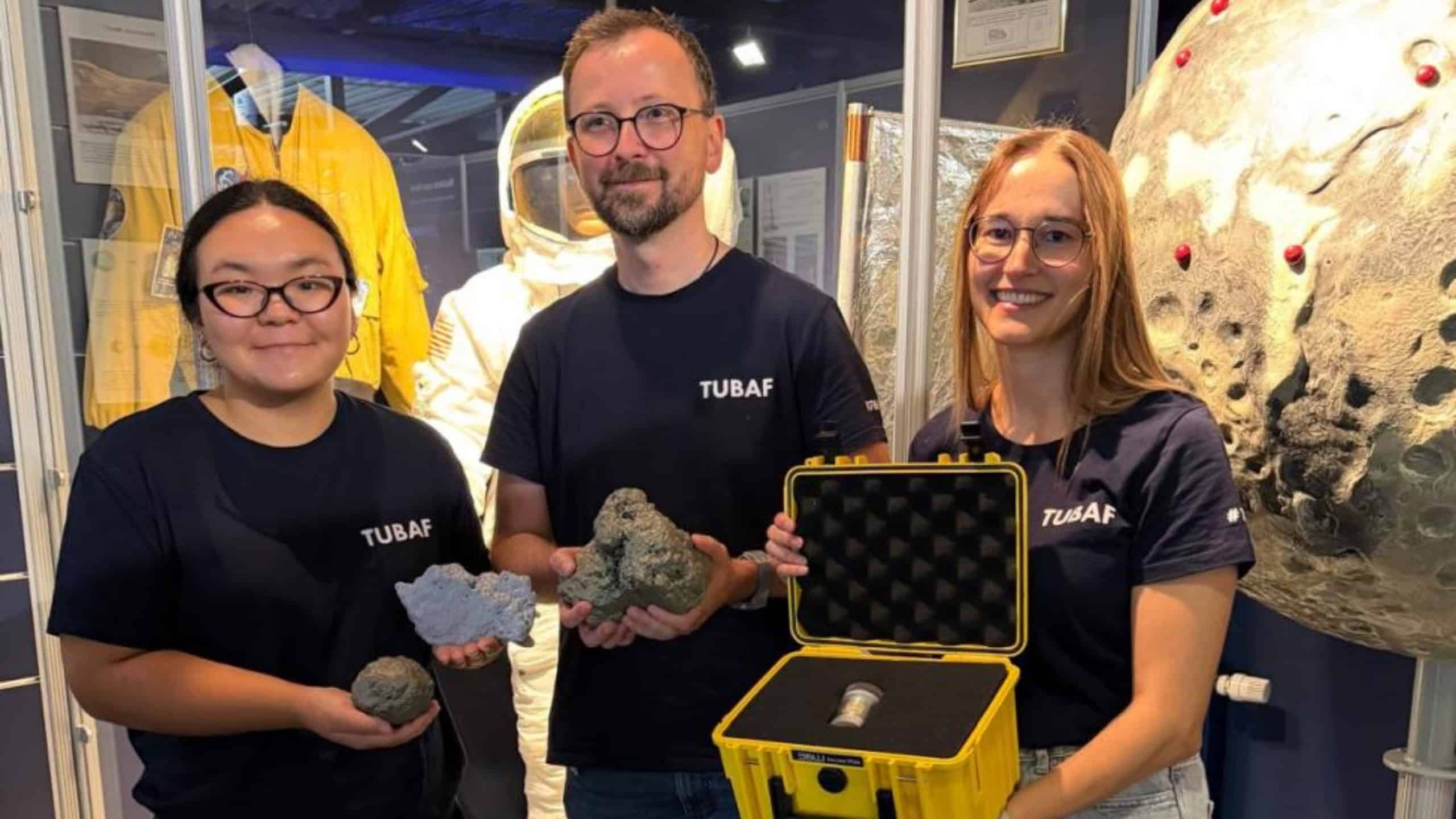
Ralf Ditscherlein (center) and his colleagues needed to return the moon sample to the museum. They also had a 3D-printed model of the fine particles. © TUBAF/S. Mongoljiibuu
Ralf Ditscherlein had actually just wanted to visit a space exhibition. But among the exhibits in Morgenröthe-Rautenkranz in the Vogtland region, the scientist from the TU Bergakademie Freiberg (TUBAF) discovered something that was particularly valuable for his research: a rare sample of lunar rock. It came from the Soviet space mission Luna 16, which brought material from the Moon to Earth in 1970. Ditscherlein asked if he could examine the sample. The chance discovery turned into a research project.
The material is called regolith. It consists of dust and small rock fragments that cover the Moon’s surface. To date, only about 380 kilograms of such samples have been brought back to Earth from the Moon. For experiments, researchers therefore often use artificial replicas made from terrestrial rock. But these have their limitations. “The shape, size, or composition of the regolith would be important, but so-called simulants can only ever replicate some properties, never all of them together,” says Ditscherlein, a research associate at the Institute for Mechanical Process Engineering and Mineral Processing Technology.
Rare lunar dust under x-ray scrutiny
The Freiberg team examined the sample using an X-ray computed tomography (CT) scanner, similar to a CT scan at a hospital. “For the CT scan, the sample does not need to be removed from its container. That was crucial to our ability to borrow it in the first place,” explains the researcher.
The scientists were able to determine the shape and size of about 150 dust particles. The images were also used to create three-dimensional models that are up to 1,500 times larger than the original particles. In the summer of 2026, the scientists returned the sample and the models to the exhibition.
Extracting oxygen from lunar rock
But why is the scientific community even interested in the shape of lunar dust particles? It can be compared to flour and sugar: While sugar usually flows freely, flour can clump together. How such materials behave depends, among other things, on the size and shape of their particles.
This could become important on the Moon in the future. Space companies and research institutions are working on processes to utilize the raw materials available there. In the MiniRoxy project, for example, Airbus and the Fraunhofer Institute for Manufacturing Technology and Applied Materials Research (IFAM) in Dresden are developing a reactor designed to extract oxygen from lunar rock. The TU Bergakademie Freiberg is also involved. The process has already been tested in the laboratory. The long-term goal is to deploy it on the Moon.
The new data from Freiberg could help researchers better investigate such technical processes. Together with researchers from the Universities of Ulm and Braunschweig, the team plans to use the results to improve synthetic substitute materials and computer models. The data is to be published as open access.
Few grains, valuable data
Other research teams have already examined significantly larger quantities of lunar dust. In the U.S., approximately 14,000 particles from Apollo samples were analyzed. A Chinese study even analyzed more than 700,000 grains.
By comparison, the Freiberg study, with about 150 particles, is small. Its particular value lies in the rare origin of the material from the Luna 16 mission. “We are very excited to see what insights we can gain from this serendipitous discovery for this and future projects,” says Prof. Urs Peuker, director of the Freiberg institute.