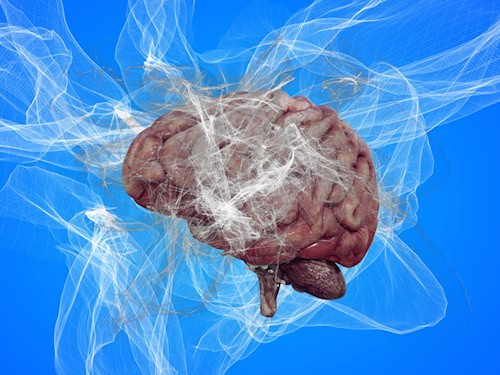

Why the human brain became so large
Our brains are significantly larger than those of chimpanzees and gorillas. Researchers at TU Dresden have now discovered that our genes are not the only factor responsible for this.
Read Aloud
0:00

A human brain organoid under a microscope. A special dye makes the shape and branching of the cells visible. © Theresa Schütze, AG Albert, CRTD
When you stand in front of the gorilla enclosure at the zoo, you’ll recognize many familiar traits: the hands, the gaze, the way the young gorillas play. And yet our brains are about three times as large as a gorilla’s. Researchers have long been puzzling over why this is the case. An international team led by Prof. Mareike Albert of the Technical University of Dresden (TUD) has now found a new piece of the puzzle.
The focus is on the neocortex, the outer layer of the cerebrum. It plays a key role in thinking, planning, and speech. “How large a brain becomes is determined during development, because that’s when most nerve cells are formed,” says Albert. “However, brain tissue from developing great apes is not available to researchers.” There are sound ethical reasons for this. Albert leads a research group at the Center for Regenerative Therapies Dresden (CRTD) and at the Department of Biology at TUD.
Same genes, different activity
That is why the team worked with organoids. These are tiny tissue structures grown in the lab from stem cells. They mimic certain characteristics of the developing brain. The researchers cultivated such organoids from cells taken from humans, chimpanzees, and gorillas.
In the regions of the genome that contain the blueprints for proteins, humans, chimpanzees, and gorillas share 98 to 99 percent of their DNA. However, the shared genes are not always equally active. “Genetic switches are short DNA segments that control how active a gene is,” explains Dr. Theresa Schütze, who led the experiments. “You can think of them as dimmer switches that upregulate or downregulate genes.”
Nearly 600 such switches were more active in the human stem cells studied than in chimpanzees and gorillas. Many of them influence genes that determine the shape cells take and how extensively they branch out. When the team switched off two of these genes in human organoids, the stem cells formed fewer extensions. In one case, fewer nerve cells were also produced.
What makes us human
Previous studies had already shown that more extensively branched stem cells can receive more signals from their environment, divide more frequently, and form more nerve cells. This could help explain why the human brain grew so large over the course of evolution.
“We’re basically working with the same building blocks, we just use them differently,” explains Albert. Previous research from Dresden had already linked individual genes to the growth of the human brain. The new study now shows that differences in how shared genes are regulated could also play a role.
Although organoids only partially replicate a real brain, they do provide insights into an early developmental phase that is otherwise difficult to study in the strictly protected great apes. “What makes us human is a fascinating question,” the professor adds. “With organoids, we can now begin to answer this question at the level of individual cells and genes.”
Original publication:
Schütze, T.M., Kolodziejczyk, A., Ditzer, N. et al. Human-specific morphoregulatory signatures in basal radial glia characterize neocortex evolution. Nat Commun 17, 10651 (2026).