11,000 samples: AI is set to gain a better understanding of rocks
At the TU Bergakademie Freiberg, thousands of wafer-thin rock samples are being digitized. The images will be used to train artificial intelligence. This could also help process raw materials more efficiently in the future.
Read Aloud
0:00
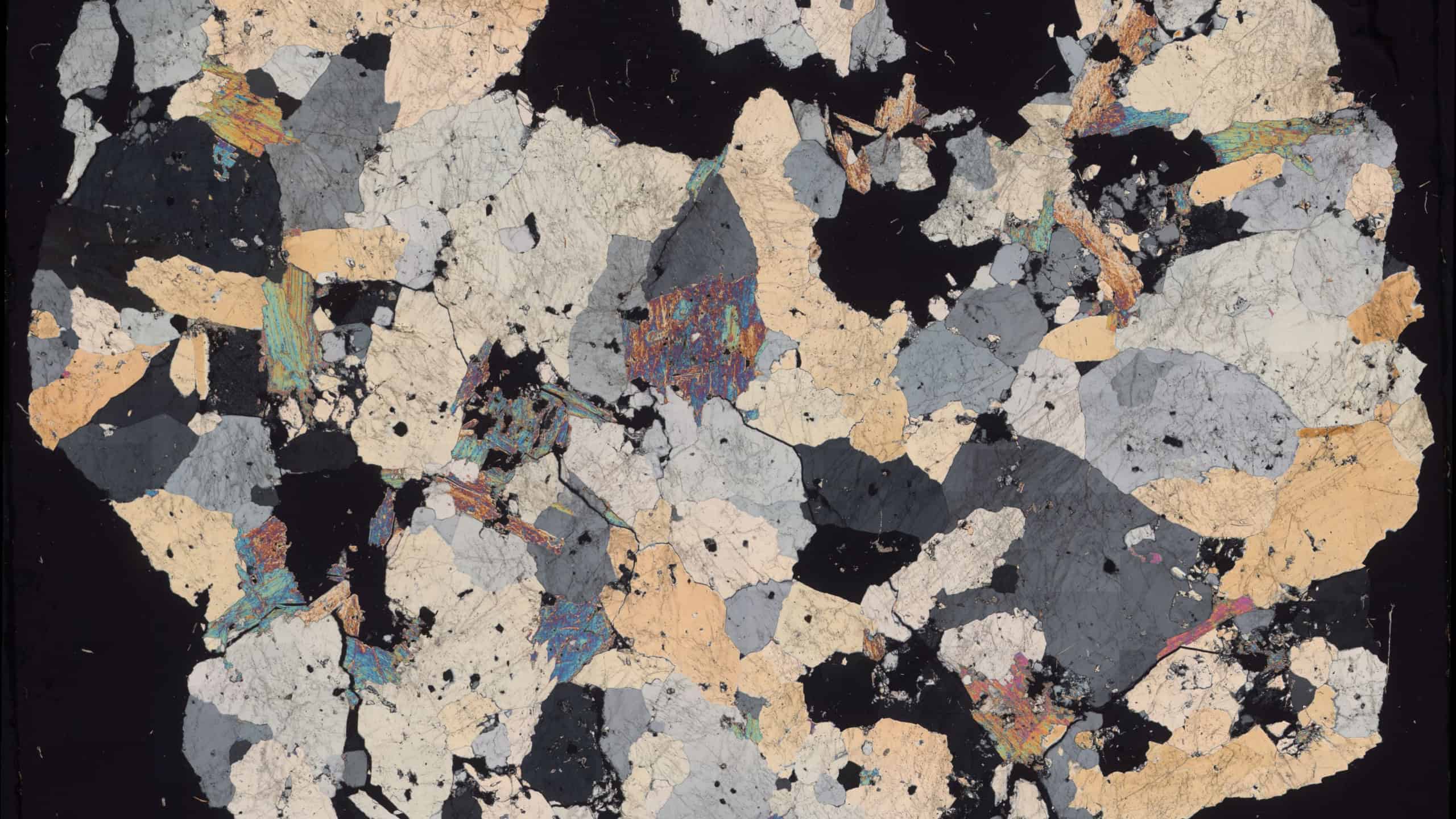
A thin section of greisen containing quartz. The TU Bergakademie Freiberg plans to digitize such wafer-thin rock samples and make them available for research using AI. © TUBAF
Many things in our everyday lives come from rocks – from the copper in our cell phones to the gravel in railroad tracks. However, it’s often impossible to tell what exactly is inside a rock with the naked eye. Only under a microscope do the various minerals and their arrangement become visible. The TU Bergakademie Freiberg now aims to make such insights usable for artificial intelligence (AI). The German Research Foundation (DFG) is funding the “AI Rocks!” project for this purpose.
Over the next two years, approximately 11,000 so-called thin sections are to be digitally recorded. These are wafer-thin slices of rock mounted on glass. They are just 0.03 millimeters thick. Under special lighting, the minerals appear in different colors and levels of brightness. An automated microscope scanner at the Freiberg University Library captures high-resolution images of the samples. This process is expected to generate approximately 300 terabytes of data.
Twenty times the same rock
A special feature is the Freiberg educational collection. For some rocks, there are as many as 20 thin sections, which were originally prepared for teaching purposes. Such series are particularly interesting for AI. They provide slightly different images of the same rock. This allows researchers to determine whether a program can recognize the key characteristics even when the images differ.
But images alone are not enough. The researchers supplement them with information about where the rocks come from, what they’re made of, and how the samples were prepared. For some, there are additional measurement values, such as how much pressure a rock can withstand and how it fractures. Such data could help in the future to crush rock using less energy and process raw materials more efficiently.
The team is also concerned with the effects of aging. In older thin sections, yellowed materials or scratches can obscure important details. That is why such damage is intentionally introduced to new samples. The researchers scan the sections before and after. Using these image pairs, they can test whether an AI can account for the disruptive changes and make the original rock structures visible again.
The same test for everyone
Researchers are already using images of thin sections to train AI programs. However, many existing datasets are small or have limited access. This makes it difficult to compare the results of different methods. This is exactly where “AI Rocks!” comes in. The Freiberg team plans to make their images and descriptions freely accessible worldwide. The first datasets are scheduled to be published via the TUBAFmedia university platform even while the project is still underway. In the long term, a scientific data archive will ensure access.
In addition, the researchers are developing standardized test tasks, known as benchmark tests. This will allow researchers from around the world to test their AI programs using the same data. This makes it easier to assess which method is best suited for a specific task.
Experts from several fields are collaborating on the project. Among those leading the effort are mineralogist Gerhard Heide and AI expert Bernhard Eidel, as well as Julia Meyer from the University Library and Andreas Kluge from the University Computing Center at TU Bergakademie Freiberg. The Senckenberg Natural History Collections in Dresden are also involved.