River restoration: Biodiversity isn't everything
In many places, rivers and streams are being restored to a more natural state. However, greater biodiversity does not automatically mean that key ecological processes will recover.
Read Aloud
0:00
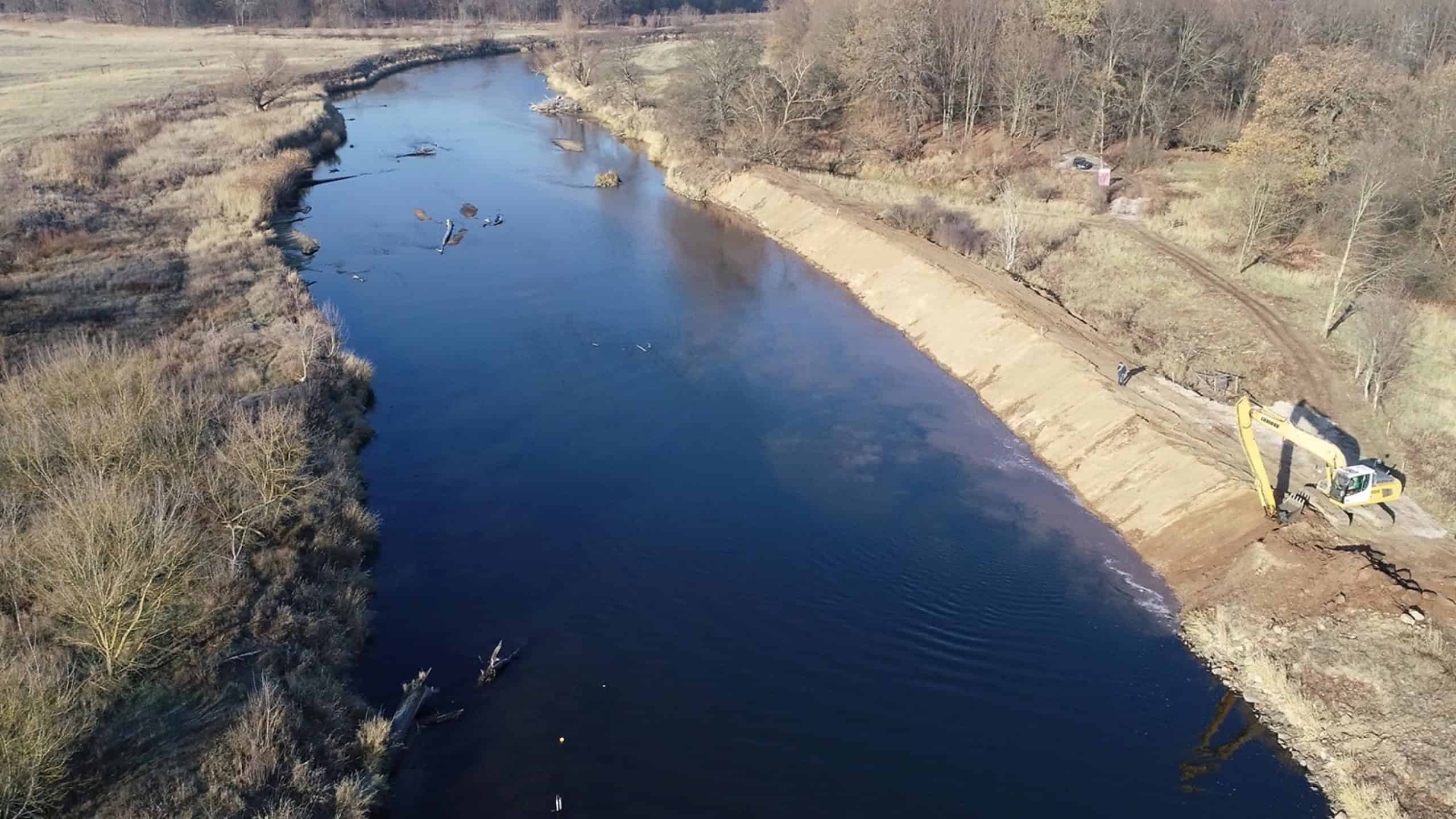
Bank reinforcements have been removed along the lower Mulde River to allow the river to develop more naturally. But is that enough? © M. Vieweg
A stream winds its way through the meadow again. Willows grow along its banks, and fallen tree trunks lie in the water. Many people will have seen restored streams like this on their walks. But just because a stream looks natural again does not mean its ecosystem is functioning as it should. This is the finding of an international study led by the Helmholtz Centre for Environmental Research (UFZ) in Leipzig.
People have straightened and dammed many rivers and streams and reinforced their banks. According to the German Environment Agency, fewer than ten percent of rivers and streams in Germany achieve at least good ecological status. Restoration projects aim to improve this situation. Measures include removing bank reinforcements, reshaping river channels and placing logs in the water.
More species, but no guarantee
A research team from 13 institutions investigated what these measures actually achieve. The researchers analysed 66 scientific studies covering 281 rivers, streams and sections of watercourses in Europe, North America, Asia and Oceania. They conducted a meta-analysis, combining and jointly evaluating findings from several studies.
On average, the researchers found positive changes in animal and plant communities. Species diversity, for example, increased. But the picture was different for the processes taking place within the water itself. Scientists call these ecosystem functions. They include algae and aquatic plants producing organic matter using sunlight, the uptake of nutrients and the decomposition of leaves in the water. These processes help determine how an aquatic ecosystem functions.
The researchers wanted to find out whether these functions recover alongside biodiversity. However, they found little clear evidence that they do. A more natural river channel and a greater diversity of animal and plant species do not necessarily mean that ecological processes have also recovered.
Measuring how rivers function
The team was able to compare nine ecological functions in detail. Only one showed a statistically significant difference between restored and degraded sections of watercourses. In the restored sections, microorganisms converted less nitrate into gaseous nitrogen compounds.
This is not necessarily a bad thing, explains study coordinator Mario Brauns from the UFZ. There may simply have been less excess nitrogen present. For the other eight functions, the researchers found no clear differences. The study therefore does not suggest that restoration measures are ineffective. Rather, it shows that greater biodiversity alone is not enough to determine whether ecological functions have also recovered.
This is particularly relevant in light of the EU Nature Restoration Regulation adopted in 2024, which makes the recovery of natural ecosystem functions one of the goals of river restoration. So far, however, the success of restoration measures has primarily been assessed by changes in the physical structure of watercourses and their animal and plant communities.
“In future, we need to include these indicators in monitoring and assessments of restoration success,” says Brauns. He is referring to measurements that show, for example, how a watercourse processes nutrients or breaks down organic matter.
This also requires suitable reference values from watercourses that are as close to their natural state as possible. Only by understanding how these processes operate under natural conditions can researchers assess whether they have actually recovered following restoration.
The scientific methods needed to measure these functions already exist. What is still missing are standardised criteria for evaluating the results and applying them in practice. In future, river restoration should therefore be assessed not only by how a stream looks and which species live there, but also by what is happening in the water.