
KI
Revised using AI
Energy & Mobility
Keeping drones and aircraft safely apart
Drones could play a key role in responding to wildfires or other disasters. But they are not alone in the air. Researchers at TU Dresden have tested how drones can be safely deployed among airplanes and helicopters. They are relying on new technology.
Read Aloud
0:00
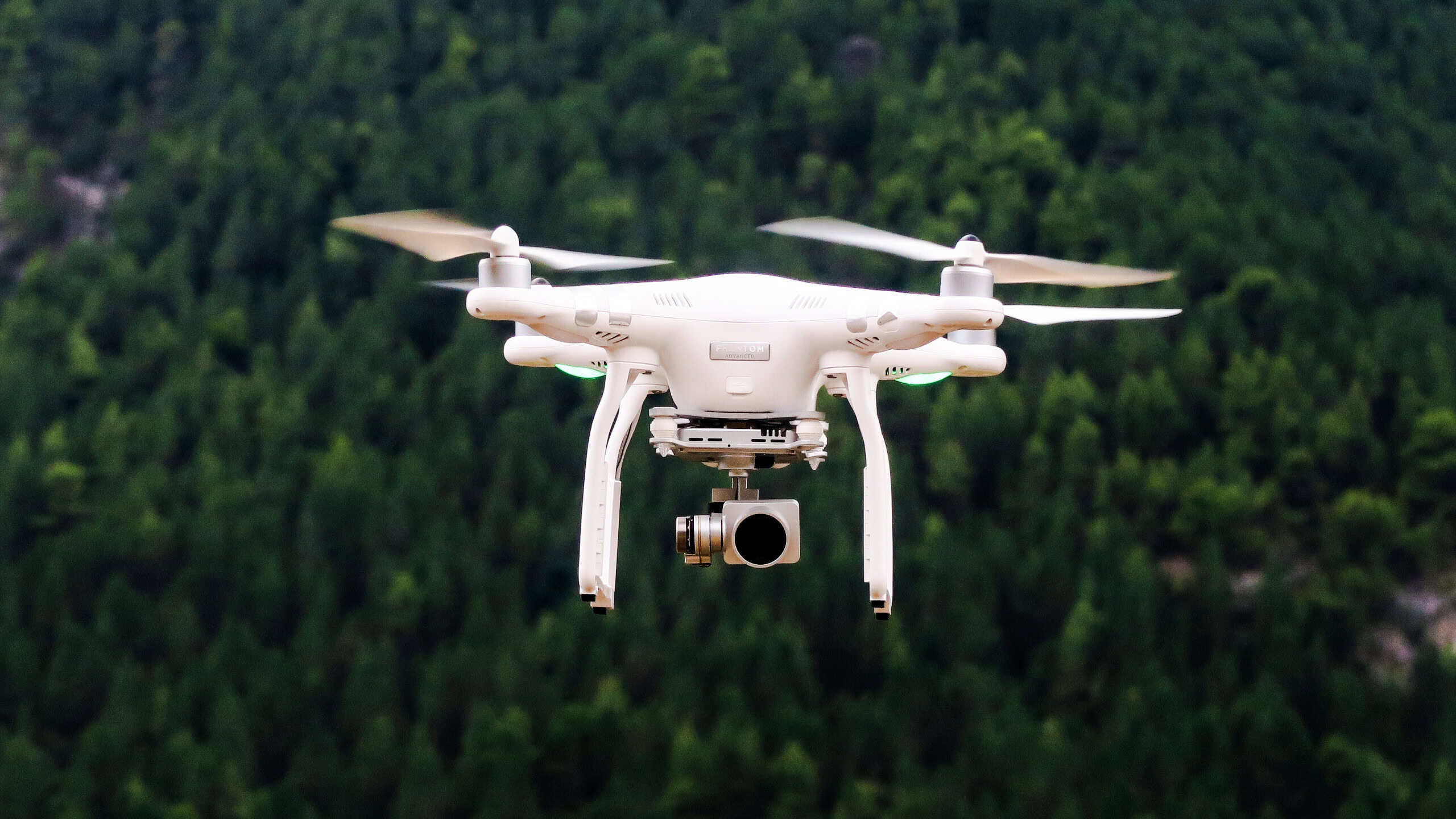
In the future, drones could also be deployed in hard-to-reach areas. Researchers at TU Dresden are investigating how drones can safely operate alongside manned aircraft. © Pexels/pixabay
A forest is on fire. The flames are spreading rapidly. Firefighting planes are flying over the area, and thick smoke is obscuring the view of emergency responders on the ground. In situations like this, drones could also help in the future. They can reach hard-to-access areas and provide information. If people are in distress, drones could also transport relief supplies.
For this to work, drones must be able to operate safely alongside manned aircraft. This is precisely what the “Air-Take-Off” research project at the Technical University of Dresden (TUD) has investigated. The researchers developed technology that enables dangerous encounters in the air to be detected early and avoided. The challenge grows as drones fly more frequently, since they share the airspace with airplanes and helicopters. All must detect and avoid one another in a timely manner.
How airplanes and drones detect each other
Strict rules already apply to drone flights, such as those near airports or beyond the pilot’s line of sight. At the same time, Europe is working to integrate drones more fully into regular air traffic. However, this also requires systems that can reliably detect manned and unmanned aircraft and keep them apart.
Part of the researchers’ work focused on how airplanes and drones perceive each other. In what is known as cooperative detection, aircraft transmit information about their position. Others receive these signals and thus know where they are. In addition, the team tested camera systems. These work even without radio signals. They automatically detect whether an aircraft, a drone, a bird, or a balloon is approaching and estimate the distance. Based on this data, the drone calculates whether it needs to take evasive action.
Another development allows drones to be transported by a manned aircraft close to the mission site. There, the aircraft drops them off and lets them continue flying on their own. This will allow drones to reach locations without roads in the future – including during a wildfire.
Flying radio tower in the air
To enable the aircraft and drone to exchange information, the researchers tested connections via Wi-Fi and cellular networks. If the radio connection on the ground fails, the manned aircraft can relay the signals. It then acts as an in-flight radio tower for the drone. For the experiment, the team used its own mobile 5G network. This cellular standard can transmit data particularly quickly.
“With Air-Take-Off, we were able to develop various building blocks for safe interaction between manned and unmanned aircraft and test them under real-world conditions,” says Hartmut Fricke, professor of aviation technology and logistics at TUD and project leader.
The researchers tested the technology at the Kamenz airfield. The airfield has its own 5G mobile network that covers only the site. It is also home to a research center for autonomous aircraft and a Cessna 172, the TU Dresden research aircraft.
There are still questions to be resolved before manned aircraft and drones can fly together in this way in normal airspace. The final report, scheduled for release in October, will first assess how reliably the technology functions under various conditions. That is also when the project – funded with approximately 2.1 million euros – will conclude.